
North East Offshore Wind Round 6: What It Means for Property Investors

North East offshore wind could bring up to 10,000 jobs. What Teesworks, Blyth and the Port of Tyne show about where rental demand really lands. Keep the excerpt on the page as it is.
A new 6GW offshore wind leasing round is coming, mostly off the North East coast, with "up to 10,000" jobs attached. The corridor has seen this before. Where the jobs were actually being delivered, rents were rising: South Tyneside up 7.6%, Northumberland up 6.9%. Where the headline jobs had not arrived at the scale announced, Redcar and Cleveland was broadly flat. Buy for the jobs you can count, not the ones in the headline.
The announcement
Last week North East and Tees Valley leaders were at WindEnergy Hamburg, one of the world's biggest wind industry events, selling the region's ports and 8,500 acres of development land.
Behind it sits The Crown Estate's Round 6: "around 6GW or more", predominantly off the North East coast, with the tender expected in the first half of 2027. The Crown Estate says it "could result in the creation of up to 10,000 direct jobs" and a "potential economic boost to the UK of over £12bn".
Read those numbers carefully. "Up to" is a ceiling, not a forecast. The £12bn is a UK figure, not a North East one. And a leasing round is the right to develop seabed, not a construction programme. The opportunity is real. It is also early.
The corridor has already run this experiment
We don't need to guess what offshore wind does to local property. Three sites on the corridor show three different outcomes.
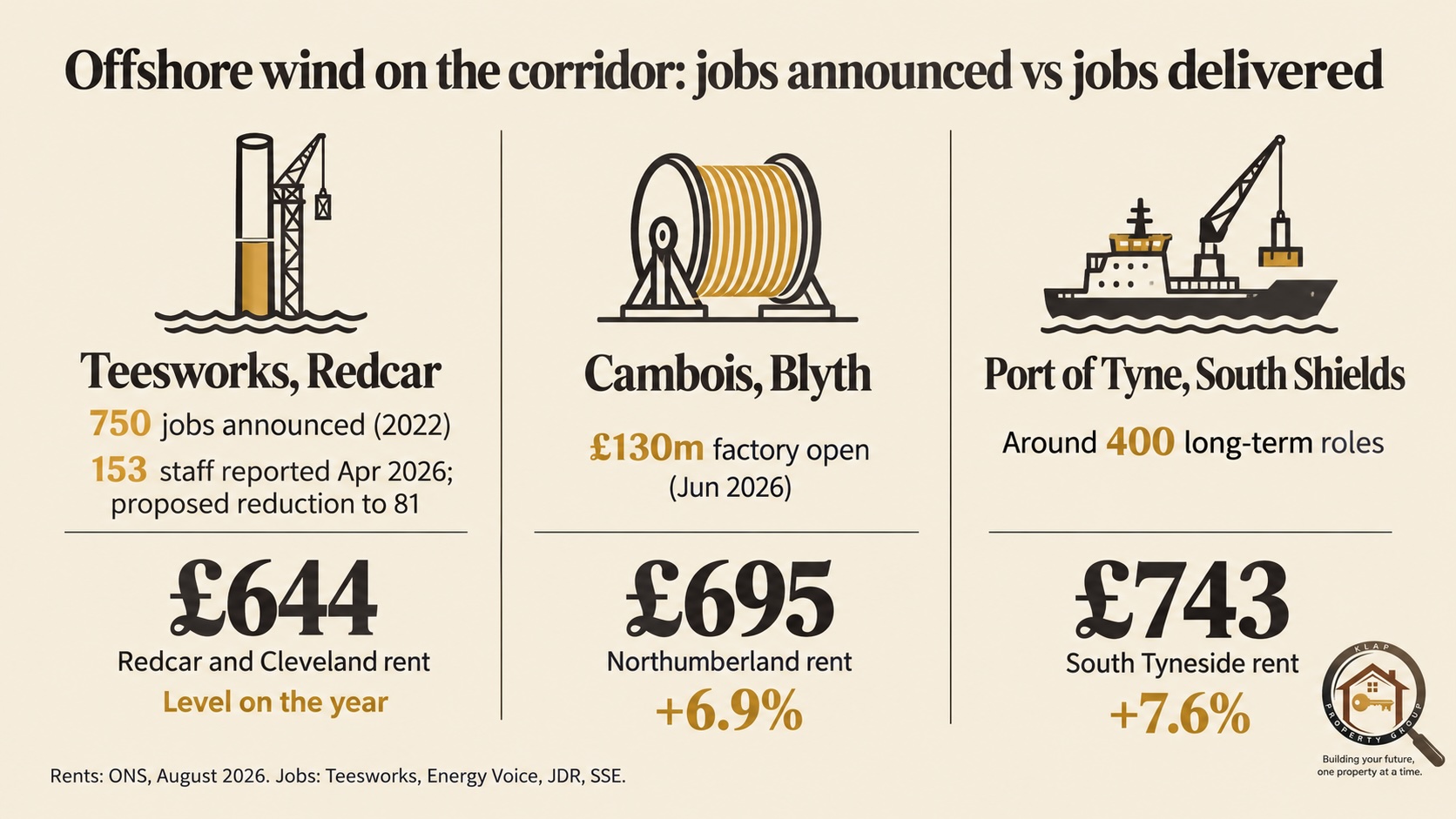
Offshore wind jobs and rents compared: Teesworks, Blyth and Port of Tyne, ONS August 2026
The latest detailed SeAH workforce figure we could verify was 153 in April 2026, when a reduction to 81 was proposed.
The site with the biggest headline has produced the weakest rental response. The one most property commentators never mention, a maintenance base in South Shields, sits in the borough with the strongest rent growth of the three.
Rents move for more than one reason. Northumberland also has the Northumberland Line and the AI Growth Zone, and ONS local figures are based on small samples. We are not claiming wind farms explain every pound. But the pattern is consistent: rent follows the payroll, not the press release.
We should own our part of this. In March we wrote that the Teesworks factory was driving a contractor rental cycle in Redcar and Middlesbrough. Production had started, so it wasn't wrong at the time. The cycle has been far weaker than the announcement suggested, and the rent data shows it.
The Seabed to Street Chain
In August we set out three layers for pricing infrastructure into a deal: status, employment, and property fundamentals. Offshore wind needs a sharper version, because there are more places for the demand to leak out.
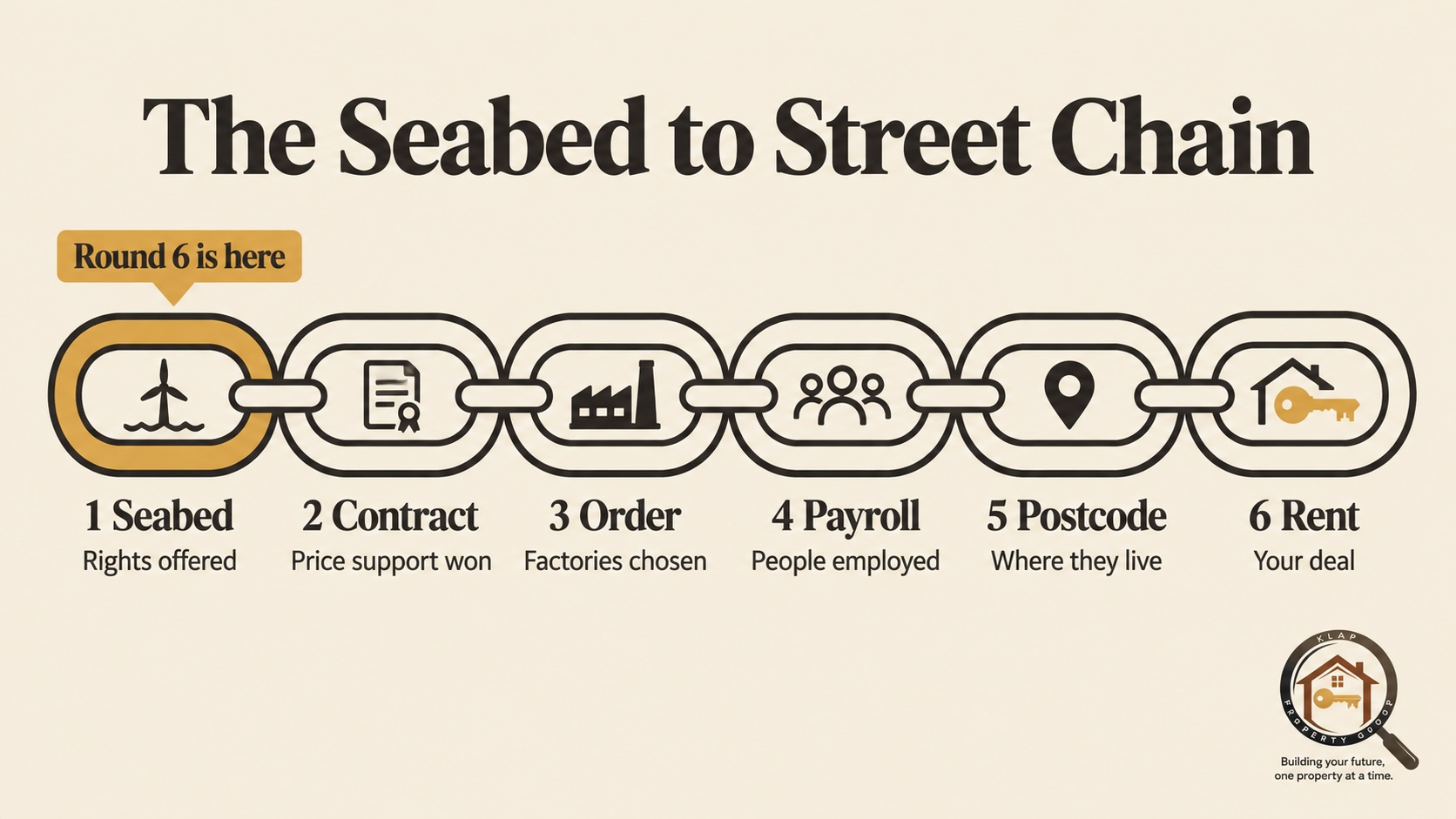
The Seabed to Street Chain: six steps from offshore wind lease to local rent
Seabed. Rights to an area are offered. Nothing is built.
Contract. A project wins a government price-support contract and becomes financeable.
Order. Turbines, foundations and cables are ordered from specific factories. This decides where the jobs go, and it may not be the North East.
Payroll. People are actually employed.
Postcode. They live somewhere, depending on commute, wages and whether the job is construction or long-term operations.
Rent. Only now does anything reach your deal.
Round 6 is at the first link. Teesworks shows how much can go wrong between the first link and the fourth.
Construction jobs and maintenance jobs are different tenants
Build phases bring a mobile workforce wanting furnished, flexible rooms near site. That demand is real, but it is tied to order books, and a single cancelled contract can move it.
Maintenance phases bring households wanting ordinary two- and three-bed lets within reach of the port. They are fewer in number, but they stay for as long as the wind farm runs.
Know which one you are buying for.
The planning clock runs separately
Three employment locations, three HMO planning positions.
In Redcar and Cleveland, the Coatham ward Article 4 Direction is "intended to come into force on 5 October 2026, subject to being confirmed by the Council". South Tyneside has had a borough-wide Article 4 since November 2025, so any small HMO there now needs planning permission. In Blyth we have found no HMO Article 4, but check the property before relying on that.
Five checks before you buy
Count the payroll. How many people are employed today, not how many were announced?
Map the postcode. Where do those workers actually live?
Match the product to the phase. Contractor rooms for a build, family lets for maintenance.
Check the ward. The planning position can change street by street.
Use today's rent. Our corridor guide puts a three-bed at £675 to £750 a month, and we underwrite at the bottom of that. If a deal only works once Round 6 has happened, it isn't ready to buy.
The takeaway
Offshore wind is one of the most credible long-term jobs stories on the North East coast. But an announcement and a tenancy are six links apart. Buy for the payroll you can see, in the postcode where it lives. Let the next 6GW be the upside, not the reason.
For town-by-town rents and planning positions across the corridor, see our reports page.
If you're looking at a deal in Blyth, South Shields or Redcar, message me directly. I'll check the jobs, the rent and the planning position before you commit, because that gap is where the wrong numbers get priced in.
Keeshan | KLAP Property Group klappropertygroup.com
Sources
The Crown Estate, Offshore Wind Leasing Round 6: https://www.thecrownestate.co.uk/our-business/marine/offshore-wind/round-6
The Crown Estate, Round 6 announcement, 26 March 2026: https://www.thecrownestate.co.uk/news/UK-looks-ahead-as-plans-for-new-leasing-round-in-2027-unveiled
Tees Valley Combined Authority, WindEnergy Hamburg delegation, 15 September 2026: https://teesvalley-ca.gov.uk/news/leaders-to-showcase-north-east-and-tees-valley-strength-at-major-global-wind-conference/
Teesworks, SeAH Wind 750 jobs announcement, 14 February 2022: https://www.teesworks.co.uk/news/seah-wind-bringing-750-jobs-with-mammoth-teesworks-offshore-factory
Energy Voice, "SeAH Wind poised to cut 72 jobs as another offshore wind contract is cancelled", 28 April 2026: https://www.energyvoice.com/renewables-energy-transition/wind/596588/seah-wind-jobs-another-offshore-contract-cancelled/
offshoreWIND.biz, JDR opens Blyth cable factory, 2 June 2026: https://www.offshorewind.biz/2026/06/02/jdr-opens-subsea-cable-manufacturing-facility-in-blyth/
SSE Renewables, Dogger Bank Wind Farm: https://www.sserenewables.com/offshore-wind/projects/dogger-bank/
ONS, Housing prices in your area, private rents August 2026 (updated 16 September 2026): Northumberland https://www.ons.gov.uk/visualisations/housingpriceslocal/E06000057/ ; South Tyneside https://www.ons.gov.uk/visualisations/housingpriceslocal/E08000023/ ; Redcar and Cleveland https://www.ons.gov.uk/visualisations/housingpriceslocal/E06000003/
Redcar and Cleveland Borough Council, Article 4 Direction (HMOs), Coatham: https://www.redcar-cleveland.gov.uk/planning/planning-strategy/article-4-direction-hmos
Shields Gazette, South Tyneside borough-wide HMO Article 4, 21 November 2025: https://www.shieldsgazette.com/news/politics/south-tyneside-council-moves-to-manage-the-amount-of-hmos-across-the-borough-5411210