
The Asking Price Isn't the Full Cost of Your Deal. Five Questions to Ask Before You Offer

The asking price isn't the full cost of your deal. This piece sets out the Offer Call, five questions to ask before you offer on a buy to let: why it is selling, what state it is in, what it all costs, what it will let for under which rules, and the number at which you walk away. It uses GOV.UK facts on stamp duty, EPC and tenancy rules, with an example sum clearly labelled. The method behind the questions is in Keeshan's book.
The asking price isn't the full cost of your deal. On a £90,000 house, the extra stamp duty for buying another home is usually £4,500 before you have paid a surveyor. Last week was what to look up on a street. This week is what to ask on the phone, and the one number to settle before you offer: the number where you walk away.
Why isn't the asking price the full cost of your deal?
Three things sit outside the price.
Stamp duty. People buying another residential property usually pay 5% on top of the standard rates. On a £90,000 house that is 5% of £90,000, so £4,500. That is an example sum, not a deal. Ask your solicitor what applies to you, especially if you buy through a company.
Condition. The law today: a landlord cannot let a covered property rated below EPC E (so F or G) without a valid exemption. The penalty is up to £2,000 for under three months and up to £4,000 for three months or more, with a £5,000 maximum per property. Separately, the Government has said it aims for as many rented homes as possible to reach EPC C by 2030. That is proposed, not yet law.
Rules. Since 1 May 2026, landlords can no longer issue section 21 no-fault notices. Most tenancies now roll on, and rent can rise once a year with two months' notice. Plan for a rolling tenancy.
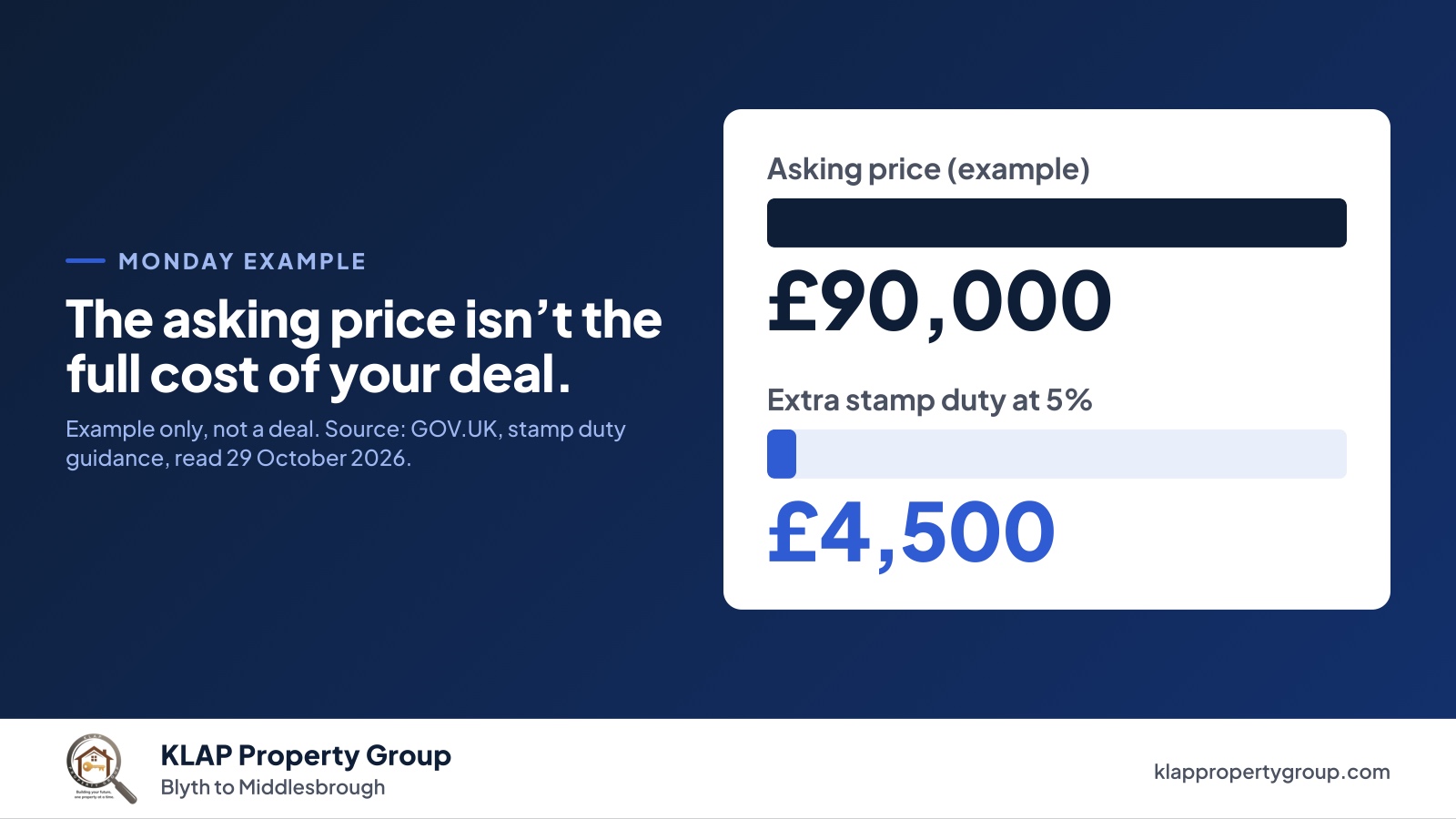
Example only: 5% of £90,000 is £4,500. Source: GOV.UK stamp duty guidance, read 29 October 2026. Check with your solicitor.
What is the Offer Call?
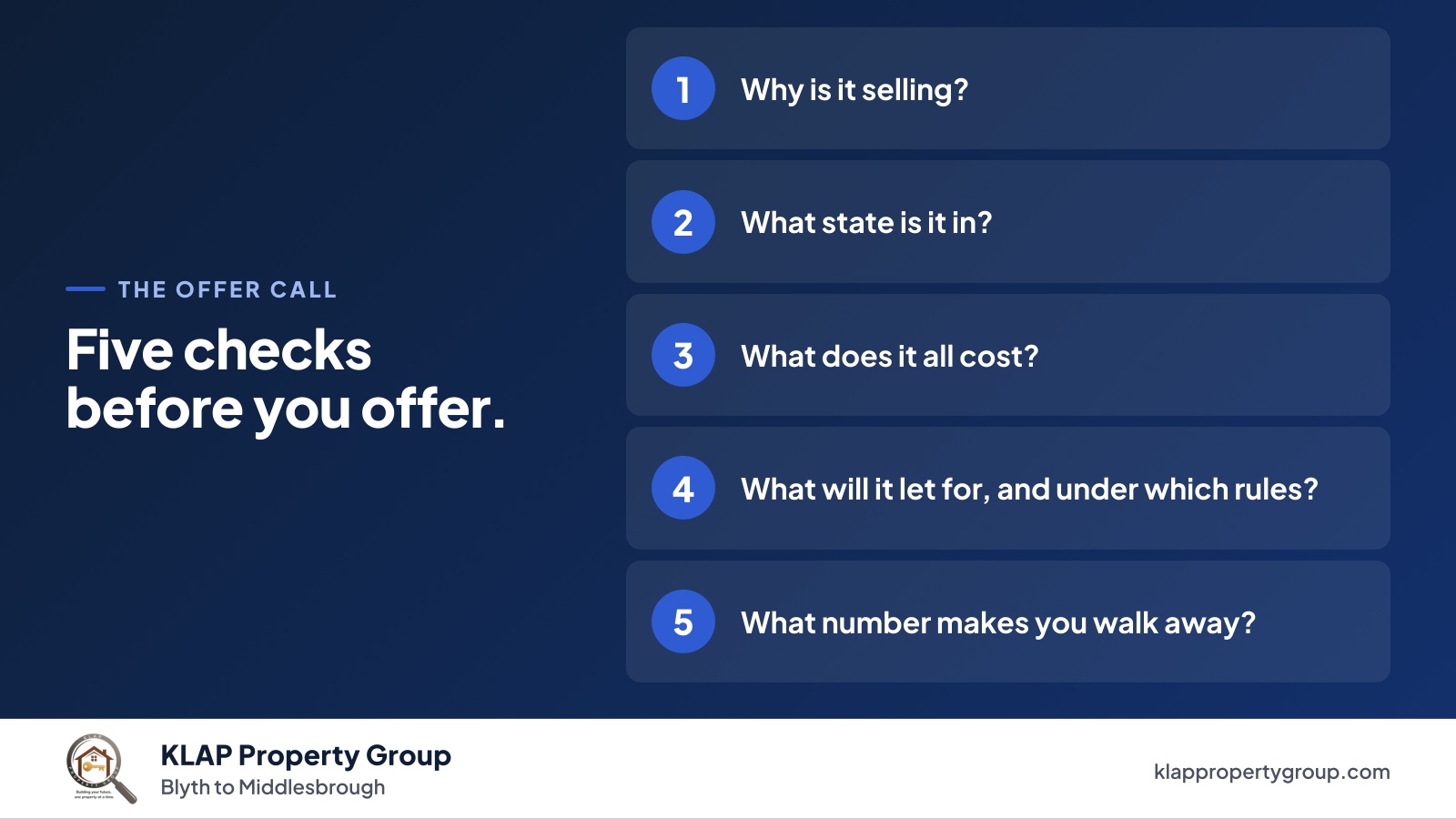
Last week's Street Check was four things to look up. The Offer Call is five things to ask. Put them to the agent, the seller, your surveyor and your lender, and write the answers down.
1. Why is it selling? Ask how long it has been on the market, whether the price has moved, and whether a sale has fallen through. The answers shape what you offer. If nobody will say, that is a missing answer. Do not treat it as good news.
2. What state is it in? Look up the EPC yourself on GOV.UK. Then ask what a survey would need to cover and get the works written down. A low rating can mean money to spend before you can let it.
3. What does it all cost? Add the price, stamp duty, works, survey and legal fees, and the weeks the house sits empty. Ask your lender for their own rates and fees. We do not quote them here, because they change and they are theirs to give.
4. What will it let for, and under which rules? Check live listings for the same size of house on the same street. Then ask the council what rules cover this house. Hartlepool shows why. Its proposed small HMO rule is not yet decided. If confirmed, it is expected from 1 December 2026. The Hartlepool Development Corporation area sits outside the council's direction, so check which side the house is on.
5. What number makes you walk away? This is the question that matters most, and it is the next section.
How do you work out a walk-away number?
Write it down before you speak to the agent. It is your highest offer, after every cost in question three, at which the deal still makes sense to you.
A deal can work at the asking price. What breaks it is optimistic rent, underestimated costs and no contingency (money set aside for things that cost more than planned). Set your walk-away number from checked rent, full costs and a contingency. Start from the total cost, not the asking price, and use a rent you have checked on the street, not the best rent you have seen.
The number is yours. We cannot set it for you, and this is not financial advice. What we can do is show you how to check the sums.
A marketed example
66 Jackson Street, Brotton, is a KLAP deal that is marketed, not sold. The agent-confirmed rent is £600 a month. That is a projection, not a result. Rent cannot be collected until the property reaches EPC E. So the rating comes before the rent.
Checks before you offer
Ask why it is selling and how long it has been listed.
Read the EPC and get the works written down.
Add every cost, not only the price.
Check the street's rent and the council's rules.
Settle your walk-away number first.
The takeaway
The asking price tells you what the seller wants. The five questions tell you what the house will cost you. Today is also a Bank Rate decision day. The Offer Call works whatever it says.
The method behind these questions is in my book, The Property Deal Finder's Handbook, which sets out how I research a deal before money moves.
Keeshan | KLAP Property Group klappropertygroup.com
Sources
All pages read 29 October 2026, except the GOV.UK minimum energy efficiency standard landlord guidance, read 1 November 2026 (page last updated 5 May 2026).
GOV.UK, Stamp Duty Land Tax: residential property rates: https://www.gov.uk/stamp-duty-land-tax/residential-property-rates
GOV.UK, Buying an additional residential property: https://www.gov.uk/guidance/stamp-duty-land-tax-buying-an-additional-residential-property
GOV.UK, Domestic private rented property minimum energy efficiency standard: landlord guidance: https://www.gov.uk/guidance/domestic-private-rented-property-minimum-energy-efficiency-standard-landlord-guidance
GOV.UK, Giving notice of possession to tenants before 1 May 2026: https://www.gov.uk/guidance/giving-notice-of-possession-to-tenants-before-1-may-2026
GOV.UK Housing Hub, Renting is changing: https://housinghub.campaign.gov.uk/renting-is-changing/
GOV.UK, Find an energy certificate: https://www.gov.uk/find-energy-certificate
Hartlepool Borough Council, HMO Article 4 consultation: https://www.hartlepool.gov.uk/planning-policy/house-multiple-occupation-hmo-article-4-consultation