
"The Prime Minister Has Described a Landlord. Make Sure It Isn't You."

On 29 September the Prime Minister took aim at "absentee landlords" who are paid through the benefit system but let their homes fall apart. Two days earlier, the Government announced that councils will be able to take over homes left empty for six months, down from two years. On the Blyth to Middlesbrough corridor that lands harder than almost anywhere, because Middlesbrough's long-term empty rate is 2.28%, nearly double England's 1.2%. But living far from your property is not the problem. Being unreachable is, and this piece gives remote investors a four-question test to prove which side of that line they are on.
On 29 September the Prime Minister promised to make it "much easier" for councils to take homes from absentee landlords who let them fall apart. Councils will also be able to take over empty homes after six months, not two years. Middlesbrough's long-term empty rate is 2.28%, nearly double England's 1.2%, so the corridor is where this lands first. Living far away is not the risk. Being unreachable is.
What the Prime Minister said
At Labour's conference on 29 September, Andy Burnham said the worst rented homes are "often owned by absentee landlords who are paid through the benefit system but refuse to reinvest anything in the upkeep of the property".
Councils will warn those landlords first. "If they refuse, we will make it much easier for councils to acquire those homes and we will legislate if necessary."
If you own a house in Middlesbrough and live in London, Dubai or Lagos, you probably read that twice. This piece is about whether it applies to you.
What has actually changed, and what hasn't
The acquisition plan is a pledge, not a law. No Bill, consultation or legal mechanism has been published. Councils can already compulsorily purchase homes for housing under the Housing Act 1985. The promise is to make that "much easier".
The empty homes change is firmer. On 27 September the Ministry of Housing announced that councils will be able to apply for an Empty Dwelling Management Order after a home has been empty for six months, not two years. It will also drop the tests on anti-social behaviour and community support.
An Empty Dwelling Management Order is simple. The council asks a tribunal for permission to take over the running of an empty home and let it out. You still own it. The council manages it.
The trigger was six months when the law started in 2006. It was raised to two years in 2012. It is now going back to six months, but no start date has been published.
One correction to what is circulating online. Some property educators on Facebook are calling this a chance to buy from landlords "forced to sell at a discount". Nothing announced forces anyone to sell. A management order is management, not a sale.
Why the corridor is first in line
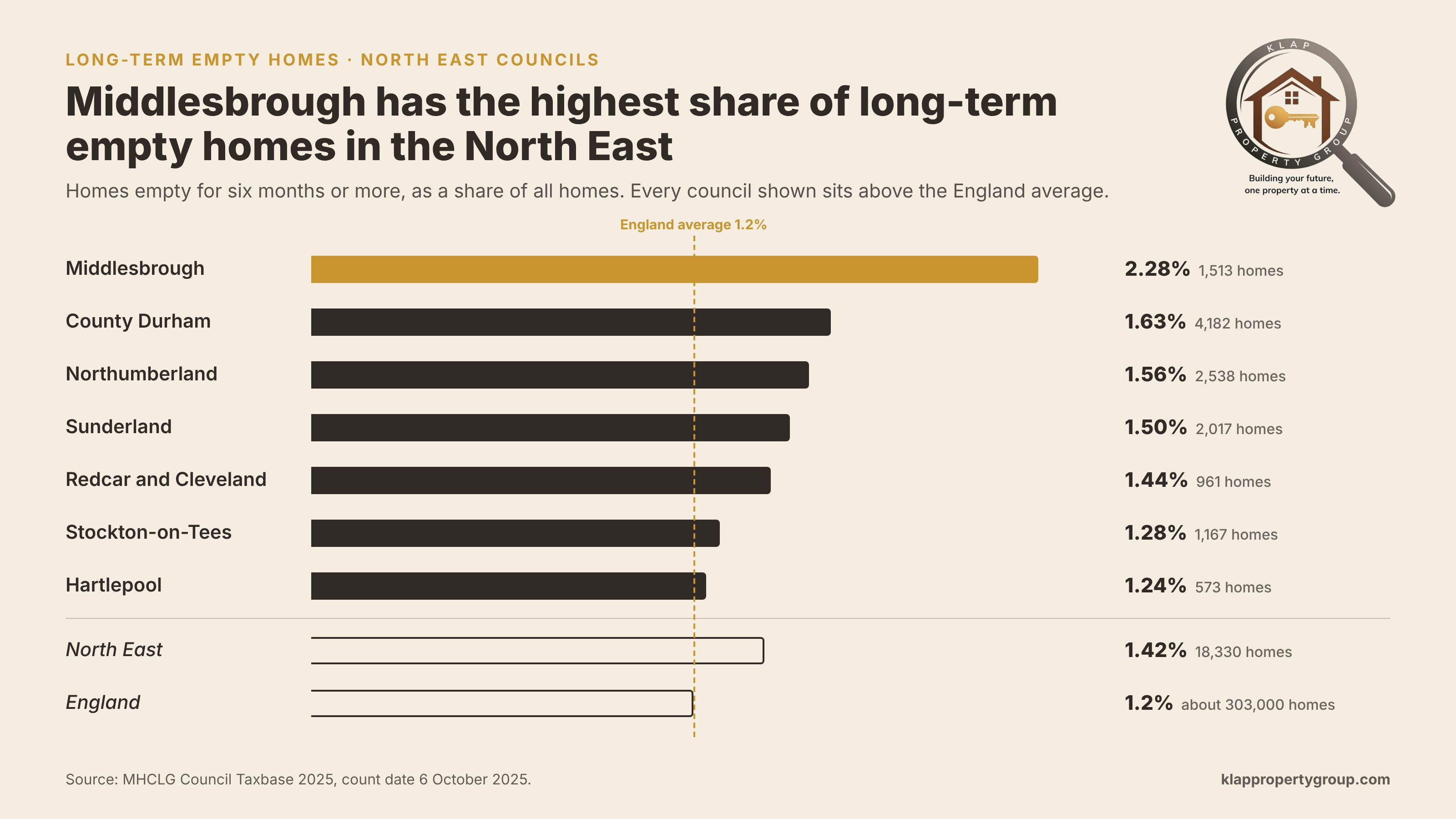
Middlesbrough has nearly twice the national share of long-term empty homes. Every council on the list above sits at or above the England average.
Now put that next to the speech. Low-priced houses. Owners who often live far away. Tenants whose rent is often paid through benefits. That is the profile the Prime Minister described, and it is a big part of the corridor's rental stock.
Councils here will have the numbers to justify using the new tools. Expect them to.
Distance is not the problem. Neglect is.
Most of the investors I work with live hundreds or thousands of miles from their property. That does not make them the landlord in the speech.
What the Prime Minister described is an owner nobody can reach, a repair list nobody acts on, and a house that drifts empty. You can be all three while living around the corner.
In August we wrote about the Compliance Discount: the gap between a property's headline yield and its real value once you price in bringing it up to standard. This speech widens that gap for anyone who has let a house slide. It narrows it for anyone who can prove they haven't.
There is one trap for investors who buy to refurbish. Under the current rules, a home that is "genuinely on the market for sale or letting" is protected from an order. A home being renovated is not on that list. The council only has to explain to the tribunal why it is going ahead anyway. A refurb that stalls for months is exactly the empty house the six-month rule is aimed at.
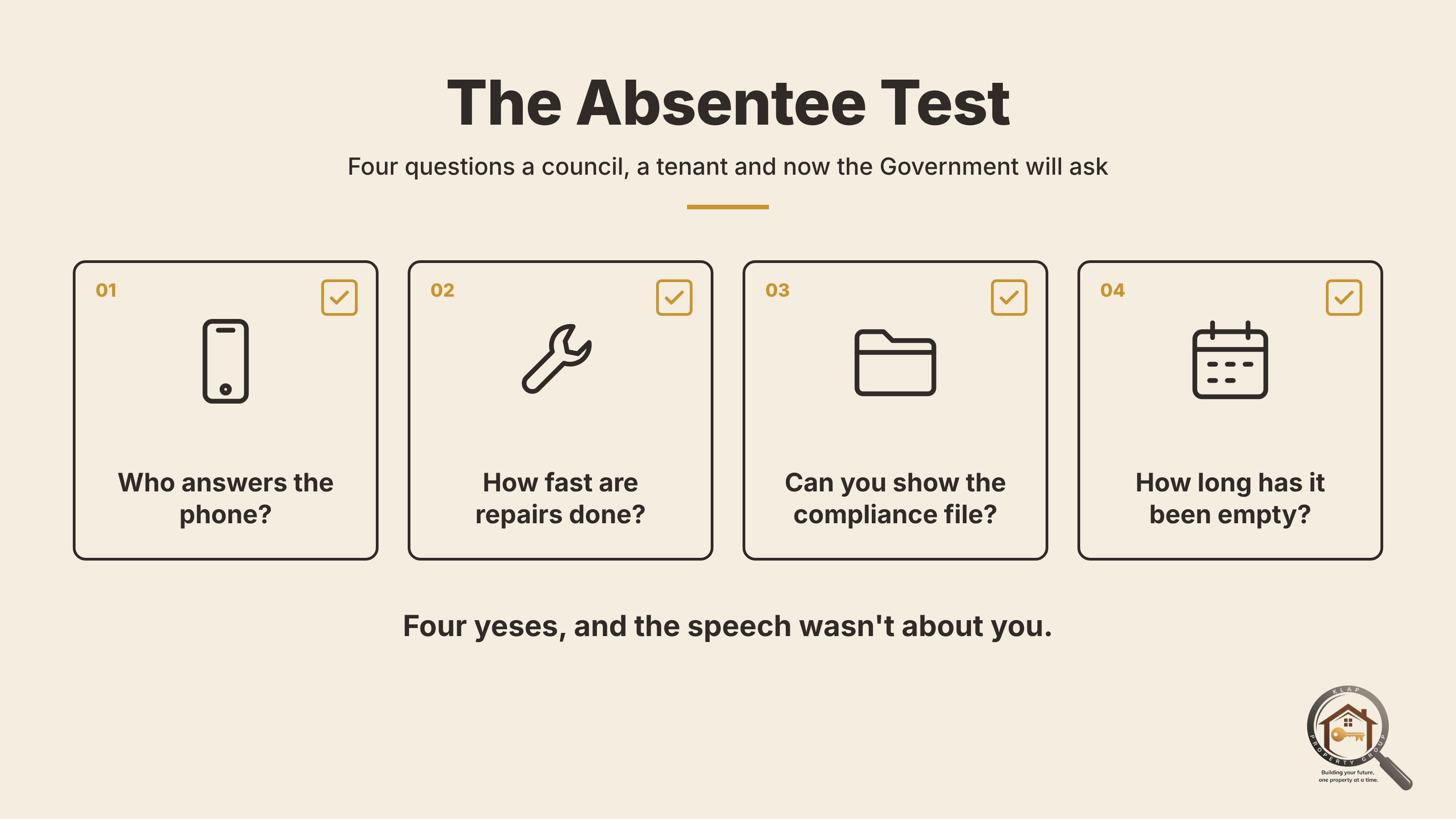
Four questions decide which side of the line you are on.
Who answers the phone? A named person, with a response time a tenant or council officer can rely on.
How fast are repairs done? Every repair is logged, dated and closed, so you can prove it.
Can you show the compliance file? Gas safety, electrical report, EPC, deposit protection and any licence the council requires, all in date and in one place.
How long has it been empty? Under six months, with the reason on paper.
Four clear answers and the speech was not about you. This is the job KLAP Lettings does for our investors, for 10% of the rent.
Checks before you buy
Ask how long it has been empty. Ask the seller, and why. A long empty history is a warning and a negotiating point.
Put the refurb on a dated plan. Keep photos and invoices that show progress. A stalled refurb now carries a new risk.
Agree management before completion. Not after the first problem.
Price the catch-up. If the house has been neglected, cost the work to bring it up to standard before you offer.
The takeaway
The Government has just told councils to look harder at absent, unreachable landlords, and the corridor has more empty homes than most. Owning from far away is fine. Being unreachable is not, and from now on it will cost more.
For town-by-town rents and planning positions across the corridor, see our reports page.
If you own a house on the corridor and you are not sure how it would score on those four questions, message me directly. I will tell you honestly, because it is cheaper to fix now than after a council letter.
Keeshan | KLAP Property Group klappropertygroup.com
Sources
Labour Party, "Six things Andy Burnham announced today at Labour Party Conference", 29 September 2026: https://labour.org.uk/updates/stories/six-things-andy-burnham-announced-today-at-labour-party-conference/
Landlord Today, "Burnham pledges new crackdown on rogue landlords" (speech quotes), September 2026: https://www.landlordtoday.co.uk/breaking-news/2026/09/burnham-pledges-new-crackdown-on-rogue-landlords/
Planning Geek, "Council acquisition of neglected rented homes to get easier" (no Bill or mechanism published), 2026: https://www.planninggeek.co.uk/2026/council-acquisition-rented-homes/
GOV.UK, MHCLG, "New reforms to bring more long-term empty homes back into use", 27 September 2026: https://www.gov.uk/government/news/new-reforms-to-bring-more-long-term-empty-homes-back-into-use--2
Housing Act 2004, Explanatory Notes on Empty Dwelling Management Orders: https://www.legislation.gov.uk/ukpga/2004/34/notes/division/6/4/2
The Housing (Empty Dwelling Management Orders) (Prescribed Exceptions and Requirements) (England) Order 2006, article 3: https://www.legislation.gov.uk/uksi/2006/367
The Housing (Empty Dwelling Management Orders) (Prescribed Period of Time and Additional Prescribed Requirements) (England) (Amendment) Order 2012 (two years, in force 15 November 2012): https://www.legislation.gov.uk/uksi/2012/2625/made
MHCLG, Council Taxbase 2025 in England, local authority long-term empty dwellings, count date 6 October 2025 (local authority data revised 21 January 2026): https://www.gov.uk/government/statistics/council-taxbase-2025-in-england
Analysis Function, "Empty homes statistics from across the UK: 2026" (England, 303,185 long-term empty, 1.2%, MHCLG Live table 615): https://analysisfunction.civilservice.gov.uk/policy-store/empty-homes-statistics-from-across-the-uk-2026/
KLAP Property Group, "Burnham Landlord Record" (the Compliance Discount), 27 August 2026